Pomegranate Sorting and Packing Service for Growers and Exporters
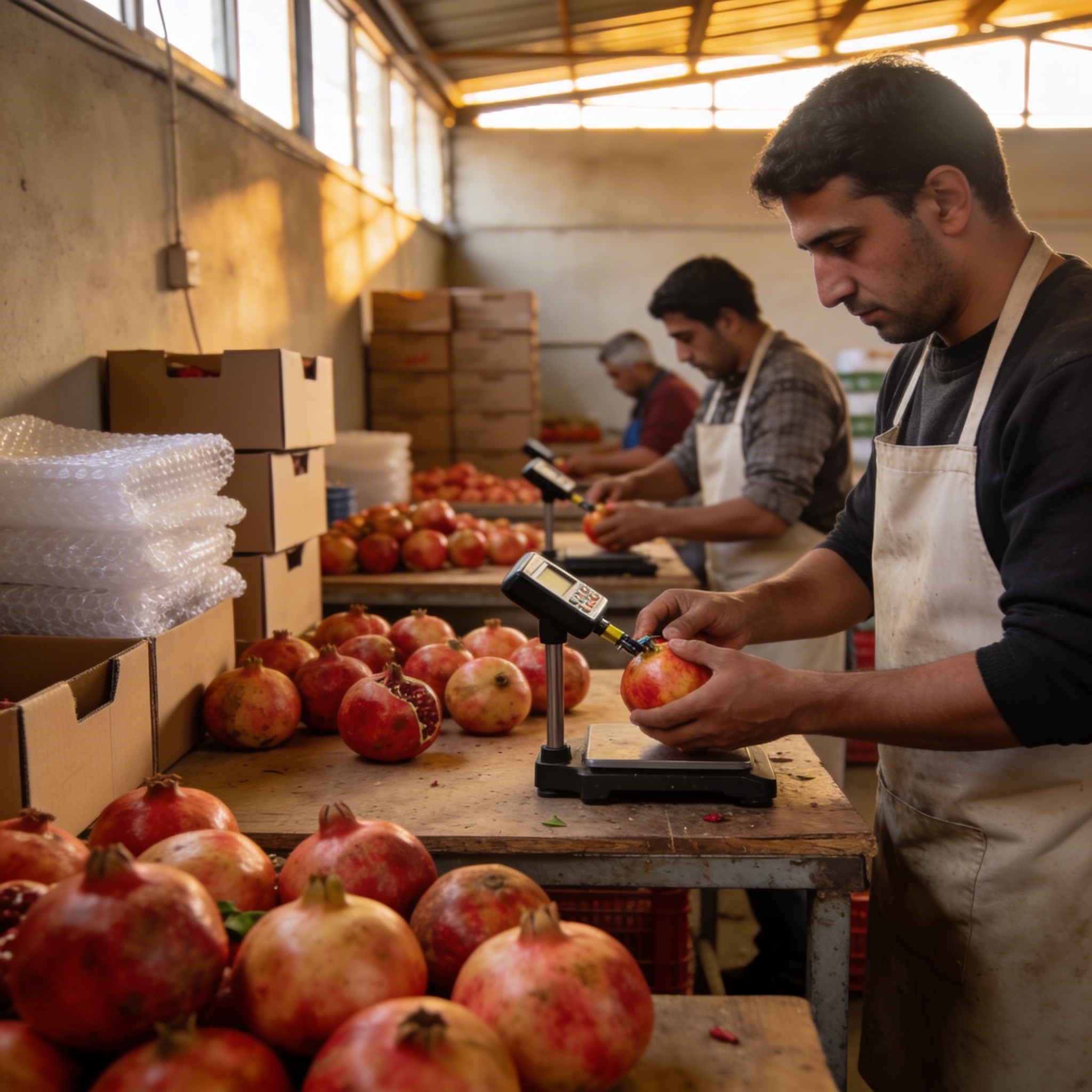
We operate a centralized facility where growers and exporters bring their harvested pomegranates for professional sorting, grading, and packing into export-ready cartons. Buyers pay because inconsistent fruit quality causes costly rejections by foreign buyers and damages their reputation for reliability.
Operator fit: This business needs an operator who is physically present on the floor daily, understands workflow efficiency, and can manage a team of manual.
Decision snapshot
Investment
AZN 9,750
Monthly profit
AZN 10,500
Payback
7 months
Customer type
B2B
Tech needed
Light tech
Sector
Agriculture
Quick Decision
Individual growers, especially mid-sized ones, cannot afford the dedicated space, specialized equipment, and trained labor needed for consistent export-grade sorting.
Exporters waste significant time and money manually re-sorting mixed-quality deliveries from multiple small farms before shipment.
Quality control is manual; one batch of poorly sorted fruit sent to a buyer can destroy your reputation and lose the client permanently.
What You Are Selling
A hands-on service that sorts, grades, and packs pomegranates to meet export standards, solving a major quality bottleneck for local growers and exporters.
Who this is for: Mid-sized pomegranate growers (10+ hectares) and local export companies who face costly rejections from foreign buyers due to inconsistent fruit quality and lack the space, labor, or expertise for professional.
- Individual growers, especially mid-sized ones, cannot afford the dedicated space, specialized equipment, and trained labor needed for consistent export-grade sorting.
- Exporters waste significant time and money manually re-sorting mixed-quality deliveries from multiple small farms before shipment.
Financial Detail
| Item | Estimated cost |
|---|---|
| Grading and sorting equipment | AZN 4,000 |
| Packing station and basic tools | AZN 2,000 |
| Business registration and permits | AZN 750 |
| Initial working capital | AZN 3,000 |
| Month 1 | Month 2 | Month 3 | Month 4 | Month 5 | Month 6 | Month 7 | Month 8 | Month 9 | Month 10 | Month 11 | Month 12 | |
|---|---|---|---|---|---|---|---|---|---|---|---|---|
| Revenue | AZN 0 | AZN 0 | AZN 0 | AZN 6,000 | AZN 8,000 | AZN 10,000 | AZN 11,000 | AZN 12,000 | AZN 12,500 | AZN 12,500 | AZN 13,000 | AZN 13,000 |
| Costs | AZN 2,500 | AZN 2,500 | AZN 2,500 | AZN 2,500 | AZN 2,500 | AZN 2,500 | AZN 2,500 | AZN 2,500 | AZN 2,500 | AZN 2,500 | AZN 2,500 | AZN 2,500 |
| Net profit | -AZN 2,500 | -AZN 2,500 | -AZN 2,500 | AZN 3,500 | AZN 5,500 | AZN 7,500 | AZN 8,500 | AZN 9,500 | AZN 10,000 | AZN 10,000 | AZN 10,500 | AZN 10,500 |
| Investment recovery | AZN -12,250 | AZN -14,750 | AZN -17,250 | AZN -13,750 | AZN -8,250 | AZN -750 | AZN 7,750 | AZN 17,250 | AZN 27,250 | AZN 37,250 | AZN 47,750 | AZN 58,250 |
Net profit = monthly revenue minus operating costs. Investment recovery = estimated running cash position after deducting the full startup investment, calculated using monthly net profit midpoints. Turns positive when startup investment is fully recovered.
Figures are indicative midpoint estimates. Actual results depend on execution, location, and market conditions.
How This Business Wins
We charge a per-kilogram processing fee with a seasonal volume minimum, enabling growers to meet export standards without capital investment.
- Close the first client on a single, paid trial batch of 300-500kg.
- First-season trial: process up to 5,000 kg for a single grower at a 10% introductory discount.
- Bounded scope: includes sorting, grading, and packing into standard 5kg export cartons for one harvest batch.
- Price per kilogram of fruit processed, with a clear fee schedule for different quality grades.
- Minimum monthly volume commitment per client during the harvest season to ensure facility utilization.
- Annual service contracts for exporters with tiered pricing based on total projected seasonal volume.
- A non-refundable deposit required to schedule and secure processing time during peak harvest weeks.
- Clear out-of-scope terms: additional fees for special packaging, labeling, or cold storage requests.
- Change-order process for any quality re-sorting requested by the client after initial processing is completed.
Customer and Buying Logic
Mid-sized pomegranate growers (10+ hectares) and local export companies who face costly rejections from foreign buyers due to inconsistent fruit quality and lack the space, labor, or expertise for professional post-harvest handling.
- Farm Manager/Owner: Cares about maximizing the price per kilo for their harvest and reducing post-harvest waste and labor costs on their farm.
- Export Company Procurement Officer: Cares about receiving uniform, predictable quality from suppliers to fulfill exacting overseas contracts without last-minute rework or delays.
- Cooperative Director: Cares about providing a tangible value-added service to member farmers to justify membership fees and strengthen the cooperative's bargaining power.
- A major overseas buyer rejects a shipment due to size or quality mix-up, causing a direct financial loss and urgent need for a solution.
- The farm expands its planted area and can no longer manage the sorting volume with its existing family or temporary labor.
- An exporter wins a new, larger contract with strict packaging specifications they cannot reliably meet with current farm suppliers.
Today, most growers sort fruit manually on their farm using temporary, untrained labor, leading to inconsistent results.
We win by being the reliable, expert partner that removes the quality risk from the grower or exporter.
How You Get First Customers
- Attend regional agricultural fairs and meetings of the Azerbaijan Fruit and Vegetable Producers and Exporters Association.
- Get introductions from local agricultural input suppliers (fertilizer, irrigation) who know which farms are expanding or exporting.
- Visit the central fruit wholesale markets in Baku and regions to talk directly with exporters and larger growers.
The founder must lead sales through in-person demonstrations.
- Direct farm visits during the summer, before harvest anxiety sets in, to present your facility and process.
- WhatsApp and phone follow-ups with contacts met at markets or through referrals, sharing photos of sorted fruit and packed cartons.
- Asking your first satisfied clients for a direct introduction or a testimonial you can share with similar growers in their network.
- Start by asking about their biggest headache with sorting and packing for their buyers.
- Show before/after photos or samples: a pile of mixed-quality fruit next to neatly sorted, graded rows in export cartons.
- Explain your step-by-step process, emphasizing the trained labor and quality checks that prevent rejections.
What You Need To Start
- Start by leasing warehouse space on the outskirts of a town where rent is lower, not in a prime industrial park.
- Buy used, sturdy sorting tables and basic equipment from closing businesses or other agro-processors.
- Begin with a core team of 3-4 sorters and you acting as the supervisor and salesperson to minimize initial payroll.
- Business registration as a limited liability company or individual entrepreneur from the State Tax Service.
- Sanitary-epidemiological permit from the relevant regional consumer market control authority for handling food products.
- Durable sorting tables (wood or stainless steel) with raised edges to prevent fruit roll-off.
- Sets of metal or hard plastic sizing rings (calibrated to common export sizes like 75-85mm, 85-95mm), digital hanging scales, and hand-held fruit graders.
- A reliable source for standard 4kg or 5kg export cartons and protective liners.
- Floor Supervisor: A trustworthy person with an eye for detail to oversee sorting quality and manage the daily workflow.
- Sorter/Packers: 3-4 reliable individuals who can work consistently and follow repetitive quality instructions.
- Driver/Labourer: Someone with a driver's license and physical strength to help load/unload client trucks and manage carton inventory.
- Experience managing a team, preferably in agriculture, logistics, or a hands-on production environment.
- Basic financial literacy to track costs per kilo, manage invoices, and understand simple profitability.
- Strong local network or comfort building one in the agricultural community of a specific region like Goychay.
Risks
- Quality control is manual; one batch of poorly sorted fruit sent to a buyer can destroy your reputation and lose the client permanently.
- Revenue is highly seasonal (peak September to January), requiring disciplined saving to cover fixed rent and skeleton staff costs for the remaining 7-8 months.
- Dependence on a few large exporters for most of your volume makes the business vulnerable if one decides to build their own facility or switch to a competitor.
First 12 Months
- 1Lease a 250-300 sqm warehouse with concrete floors, good ventilation, and truck access in a key pomegranate zone like Goychay or Shamkir.
- 2Source essential equipment: sturdy wooden sorting tables, metal sizing rings calibrated to buyer specs, digital scales, and a supply of internationally approved cardboard cartons and liners.
- 3Recruit and train a team of 5-7 sorters and one supervisor, focusing on visual defect identification, size grading accuracy, and gentle handling to prevent bruising.
- 4Personally visit 20-30 target growers and exporters during the pre-harvest period (July-August) to demonstrate your setup, offer a paid trial sort of their first 500kg, and lock in 3-4 anchor clients before harvest begins.
Final Verdict
This is an attractive service business with clear demand from growers and exporters needing reliable quality control. The key risk is severe seasonal cash flow fluctuation and high client concentration.
This business needs an operator who is physically present on the floor daily, understands workflow efficiency, and can manage a team of manual laborers with clear instructions and consistent oversight. You must be comfortable building trust through face-to-face relationships with farmers and export managers, not just over the phone. Basic numeracy for weighing, invoicing, and cost tracking is essential, but deep technical agronomy knowledge is not required.