Dried Fruit Processing for Export and Wholesale
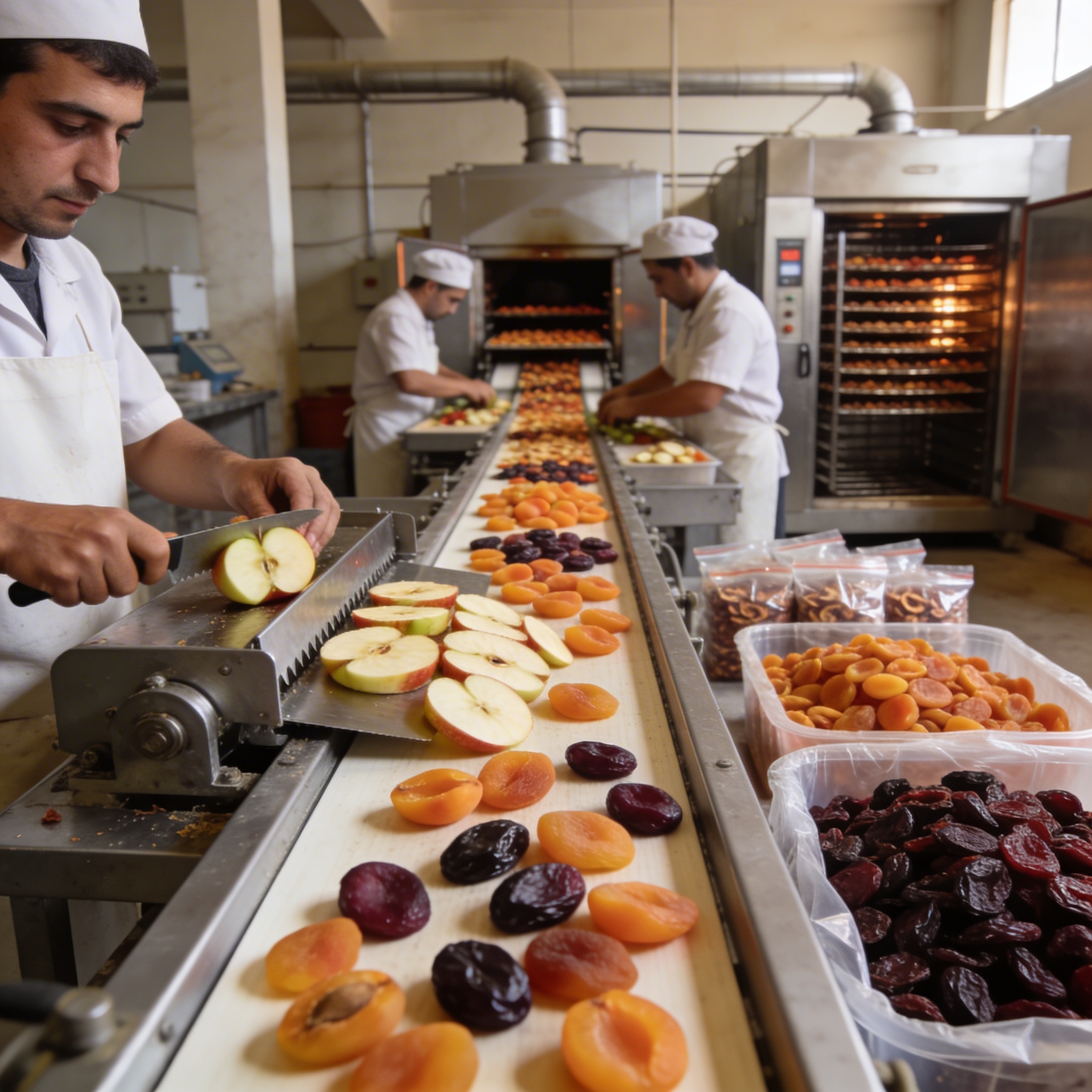
You operate a small processing facility that cleans, slices, dries, and packages fruits like apples, apricots, and plums into shelf-stable dried products. Buyers pay because sourcing consistent quality and volume directly from scattered farmers is unreliable and leads to spoilage losses during transport.
Operator fit: This business needs an operator who is comfortable moving between the farm and the office.
Decision snapshot
Investment
AZN 57,000
Monthly profit
AZN 17,500
Payback
~13 months
Customer type
B2B
Tech needed
Light tech
Sector
Agriculture
Quick Decision
Farmers in regions like Goychay or Shamakhi have seasonal surpluses where fruit sells for little or spoils, providing a cheap and available raw material.
Exporters and large distributors have contracts with foreign supermarkets requiring a steady supply of identical product, which individual farmers cannot guarantee.
Fruit prices and quality fluctuate between harvest and off-seasons, which can erase your margin if your sales price is fixed but your input cost rises.
What You Are Selling
You buy surplus fruit from local farmers, process it into packaged dried fruit, and sell directly to food distributors and exporters who need a reliable, consistent supply.
Who this is for: Food export companies and national distributors in Azerbaijan who need a reliable, consistent supply of packaged dried fruit to fulfill their own contracts with foreign supermarkets and domestic retail chains.
- Farmers in regions like Goychay or Shamakhi have seasonal surpluses where fruit sells for little or spoils, providing a cheap and available raw material.
- Exporters and large distributors have contracts with foreign supermarkets requiring a steady supply of identical product, which individual farmers cannot guarantee.
Financial Detail
| Item | Estimated cost |
|---|---|
| Drying equipment and machinery | AZN 20,000 |
| Factory setup and renovation | AZN 11,500 |
| Initial fruit inventory and packaging | AZN 7,500 |
| Business registration and food safety permits | AZN 3,000 |
| Working capital for first 3 months | AZN 15,000 |
| Month 1 | Month 2 | Month 3 | Month 4 | Month 5 | Month 6 | Month 7 | Month 8 | Month 9 | Month 10 | Month 11 | Month 12 | |
|---|---|---|---|---|---|---|---|---|---|---|---|---|
| Revenue | AZN 0 | AZN 0 | AZN 0 | AZN 0 | AZN 0 | AZN 0 | AZN 18,000 | AZN 20,000 | AZN 22,000 | AZN 23,000 | AZN 24,000 | AZN 25,000 |
| Costs | AZN 7,500 | AZN 7,500 | AZN 7,500 | AZN 7,500 | AZN 7,500 | AZN 7,500 | AZN 7,500 | AZN 7,500 | AZN 7,500 | AZN 7,500 | AZN 7,500 | AZN 7,500 |
| Net profit | -AZN 7,500 | -AZN 7,500 | -AZN 7,500 | -AZN 7,500 | -AZN 7,500 | -AZN 7,500 | AZN 10,500 | AZN 12,500 | AZN 14,500 | AZN 15,500 | AZN 16,500 | AZN 17,500 |
| Investment recovery | AZN -64,500 | AZN -72,000 | AZN -79,500 | AZN -87,000 | AZN -94,500 | AZN -102,000 | AZN -91,500 | AZN -79,000 | AZN -64,500 | AZN -49,000 | AZN -32,500 | AZN -15,000 |
Net profit = monthly revenue minus operating costs. Investment recovery = estimated running cash position after deducting the full startup investment, calculated using monthly net profit midpoints. Turns positive when startup investment is fully recovered.
Figures are indicative midpoint estimates. Actual results depend on execution, location, and market conditions.
How This Business Wins
Price per kilogram of packaged dried fruit, with volume discounts for container-sized export orders, while protecting margins with cost-plus pricing for raw materials.
- Close the first client on a small, one-off order (100-200 kg) for a single fruit type.
- Offer a first-batch discount for a trial order of 100kg of a single fruit type (e.g., dried apricots).
- Include free delivery within Baku for the first order to reduce buyer friction.
- Charge per kilogram of packaged dried fruit, with pricing tiers for 100kg, 500kg, and full pallet (1,000kg) orders.
- Base pricing on a cost-plus model: fresh fruit market price + fixed processing fee + target margin, reviewed quarterly.
- Require a 30% deposit on all first-time orders and orders over 500kg, with net-30 terms for established buyers.
- Formalize all orders with a purchase order specifying fruit type, grade, packaging, and delivery date, with fixed pricing only for that order.
- Define a clear raw material cost adjustment clause for orders placed more than 30 days in advance.
- Strictly classify custom packaging, expedited drying, or additional sorting as out-of-scope services with separate fees.
Customer and Buying Logic
Food export companies and national distributors in Azerbaijan who need a reliable, consistent supply of packaged dried fruit to fulfill their own contracts with foreign supermarkets and domestic retail chains. They struggle with quality inconsistency and spoilage when sourcing directly from scattered smallholder farmers.
- Export Manager at a food trading company: Cares about consistent quality, reliable delivery schedules, and proper export documentation to meet their overseas client's standards.
- Procurement Officer for a supermarket distributor: Focused on price per kilogram, shelf life, and packaging that looks good on store shelves. Needs volume guarantees.
- Owner of a wholesale stall at the Baku Wholesale Market: Wants a good margin, product that sells quickly, and a supplier who is responsive and delivers to the market.
- Their usual farmer supplier had a bad harvest, leaving them short on product for a key order.
- They lost a shipment of fresh fruit to spoilage during transport and need a more stable supply.
- A foreign buyer is requesting 'locally sourced' certification, which imported dried fruit cannot provide.
Buyers currently try to aggregate fruit themselves from multiple farmers, which leads to inconsistent quality and frequent spoilage.
You are the reliable local link between Azerbaijan's orchards and commercial buyers.
How You Get First Customers
- Visit the Baku Wholesale Market (Bakı Kənd Təsərrüfatı Məhsulları Bazarı) to identify large wholesale operators supplying shops and bakeries, and ask for introductions to their export-focused counterparts.
- Contact food export companies with offices in Baku by searching for Azerbaijani dried fruit and nut exporters on local B2B trade portals, then reach out to their procurement managers.
- Attend local agri-food exhibitions and trade days, which are attended by national distributors and specialty store buyers looking for new packaged goods suppliers.
This is a founder-led, sample-driven sale.
- Direct, in-person visits to wholesale market buyers and exporter offices with samples.
- Phone and WhatsApp follow-ups after initial contact, sharing photos of the production process and certificates.
- Word-of-mouth referrals from your initial farmer suppliers to their buyer contacts.
- Start with the buyer's pain: 'I understand you need a steady supply of dried apricots for your exports.'
- Show your sample: 'This is from last month's harvest in Goychay, processed to 18% moisture for maximum shelf life.'
- Explain your model: 'We work directly with farmers there, so we control quality from the orchard. We can guarantee you 500 kg every month that looks and tastes exactly like this.'
What You Need To Start
- Start by renting the smallest functional processing space you need, not a large factory.
- Buy one used industrial dehydrator initially instead of two new ones; add the second machine after securing recurring orders.
- Negotiate with farmers to pay for fruit 7-10 days after you receive it, aligning their payment with your incoming buyer cash.
- Food production license from the relevant local sanitary-epidemiological station.
- Tax registration as a legal entity or sole entrepreneur.
- Fire safety inspection certificate for your processing facility.
- Industrial electric dehydrator(s).
- Commercial fruit slicer/corer.
- Industrial scale, vacuum sealer, and packaging heat sealer.
- Basic laboratory tools for moisture and quality testing.
- A production assistant for cleaning, slicing, and loading dehydrators.
- A driver with a van for collecting fruit and delivering finished goods.
- Practical understanding of agriculture and seasonal fruit quality.
- Experience in negotiation, trading, or B2B sales, preferably in food.
- Basic administrative skill to manage invoices, payments, and simple quality records.
Risks
- Fruit prices and quality fluctuate between harvest and off-seasons, which can erase your margin if your sales price is fixed but your input cost rises.
- Becoming dependent on one or two large buyers is dangerous; if a key client delays payment for 60-90 days, you may not have cash to pay farmers.
- A critical machine like a dehydrator breaking during peak season can halt production for days, causing missed deadlines and lost buyer trust.
First 12 Months
- 1Rent a space with reliable water and three-phase power near a fruit-growing region to cut transport costs for raw fruit.
- 2Buy essential equipment: two industrial dehydrators, a commercial slicer, a vacuum sealer, and basic quality control tools like a moisture analyzer.
- 3Set up supply agreements with 3-5 local orchard owners or a cooperative, agreeing on quality grades and a pricing formula tied to fresh market prices.
- 4Obtain basic food safety certification, run test batches, then take physical samples to wholesale buyers at the Baku Wholesale Market and food export offices to secure first orders.
Final Verdict
This is an attractive opportunity because it addresses a clear supply chain gap for exporters with reliable, processed product. The key risk is margin compression from volatile fruit input costs against fixed-price purchase orders.
This business needs an operator who is comfortable moving between the farm and the office. You should be good at negotiating prices with farmers, meticulous about consistent product quality, and persistent in following up with buyers for payments. Experience in agriculture, food handling, or wholesale trading is a strong advantage.