Reliable Seedling Supply for Commercial Farms in Azerbaijan
You sell trays of vegetable and herb seedlings to professional growers. Farmers pay because starting plants from seed is time-consuming, requires specific skills, and often results in uneven or weak plants that hurt yields.
Operator fit: This business needs an operator who is comfortable with both hands-on nursery management and direct farmer sales.
Decision snapshot
Investment
AZN 47,750
Monthly profit
AZN 16,500
Payback
~13 months
Customer type
B2B
Tech needed
Light tech
Sector
Agriculture
Quick Decision
Greenhouses running continuous crops cannot afford delays from poor seed germination and need a local, on-time supplier.
Vegetable farms selling to Baku markets or regional bazaars lose significant income if their own seedling batch fails, making reliable plants a cost-effective insurance.
Delivering a batch of weak or diseased plants will ruin your reputation in the tight-knit local farming community; consistent quality is your only marketing.
What You Are Selling
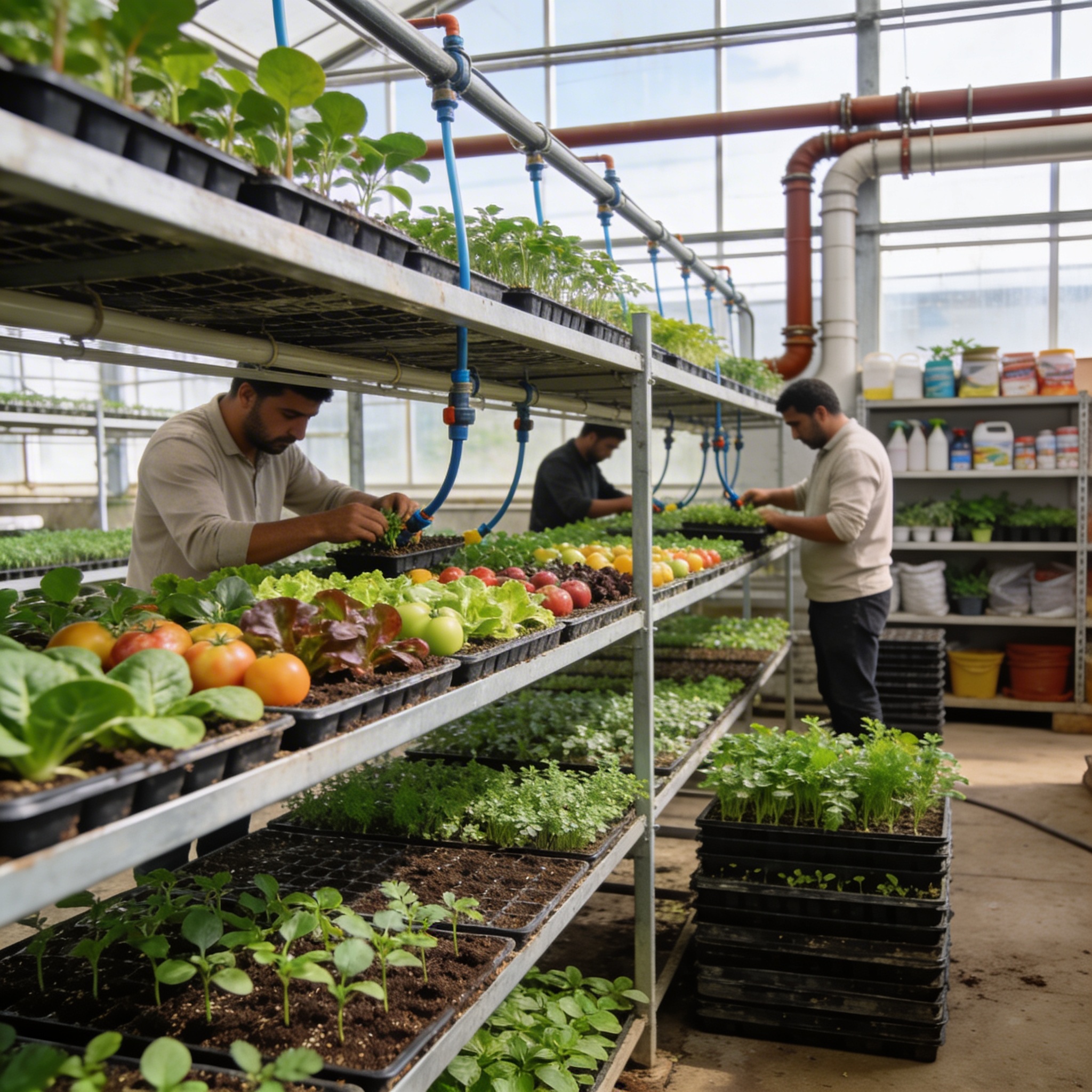
You grow and sell robust, ready-to-plant vegetable and herb seedlings to local commercial farms and greenhouses, saving them labor and reducing crop failure risk.
Who this is for: Medium-sized commercial vegetable farms and greenhouse complexes in regions like Absheron, Ganja, and Shirvan that supply local markets.
- Greenhouses running continuous crops cannot afford delays from poor seed germination and need a local, on-time supplier.
- Vegetable farms selling to Baku markets or regional bazaars lose significant income if their own seedling batch fails, making reliable plants a cost-effective insurance.
Financial Detail
| Item | Estimated cost |
|---|---|
| Greenhouse Construction & Setup | AZN 18,500 |
| Irrigation & Climate Control Systems | AZN 10,500 |
| Initial Seed Stock & Growing Media | AZN 5,500 |
| Business Registration & Permits | AZN 3,500 |
| Working Capital (3 Months) | AZN 9,750 |
| Month 1 | Month 2 | Month 3 | Month 4 | Month 5 | Month 6 | Month 7 | Month 8 | Month 9 | Month 10 | Month 11 | Month 12 | |
|---|---|---|---|---|---|---|---|---|---|---|---|---|
| Revenue | AZN 0 | AZN 0 | AZN 0 | AZN 0 | AZN 0 | AZN 0 | AZN 16,000 | AZN 18,000 | AZN 20,000 | AZN 22,000 | AZN 24,000 | AZN 24,000 |
| Costs | AZN 7,500 | AZN 7,500 | AZN 7,500 | AZN 7,500 | AZN 7,500 | AZN 7,500 | AZN 7,500 | AZN 7,500 | AZN 7,500 | AZN 7,500 | AZN 7,500 | AZN 7,500 |
| Net profit | -AZN 7,500 | -AZN 7,500 | -AZN 7,500 | -AZN 7,500 | -AZN 7,500 | -AZN 7,500 | AZN 8,500 | AZN 10,500 | AZN 12,500 | AZN 14,500 | AZN 16,500 | AZN 16,500 |
| Investment recovery | AZN -55,250 | AZN -62,750 | AZN -70,250 | AZN -77,750 | AZN -85,250 | AZN -92,750 | AZN -84,250 | AZN -73,750 | AZN -61,250 | AZN -46,750 | AZN -30,250 | AZN -13,750 |
Net profit = monthly revenue minus operating costs. Investment recovery = estimated running cash position after deducting the full startup investment, calculated using monthly net profit midpoints. Turns positive when startup investment is fully recovered.
Figures are indicative midpoint estimates. Actual results depend on execution, location, and market conditions.
How This Business Wins
We price by the seedling tray, with a minimum order for delivery, to secure cash flow for production and align with the seasonal planting windows of commercial farms.
- Close the first client on a paid, upfront order for 5-10 trays of a single, high-demand variety like tomatoes.
- Offer a 'First Block' trial: 50 trays of a single, high-demand variety (e.g., tomato) at a 10% introductory discount.
- Include free delivery within the region for this initial order to demonstrate reliability and plant quality.
- Charge per standard seedling tray (e.g., 72-cell tray), with pricing varying by crop variety and order volume.
- Require a minimum order of 50 trays for free delivery to a single farm or greenhouse location.
- Collect a 30% deposit on pre-orders to secure seasonal slots and fund upfront propagation costs.
- Define order scope clearly: price covers standard tray delivery; special timing or site conditions incur extra fees.
- Require written change orders for any post-booking alterations to variety mix or delivery dates, with adjusted pricing.
- State that payment terms are net 15 days post-delivery; late payments accrue a 1.5% monthly interest charge.
Customer and Buying Logic
Medium-sized commercial vegetable farms and greenhouse complexes in regions like Absheron, Ganja, and Shirvan that supply local markets. These buyers face labor-intensive, unreliable seed-starting processes and need uniform, vigorous seedlings delivered on their exact planting dates to protect crop yields.
- Greenhouse Manager: Cares about plant uniformity, exact delivery dates to match empty greenhouse bays, and disease-free stock to prevent spread in a closed environment.
- Farm Owner: Focused on total cost, survival rate after transplanting, and reliability to ensure their market supply contracts are met on time.
- Orchard Replanting Supervisor: Needs specific, hardy varieties for outdoor conditions, cares about root structure strength, and values bulk delivery coordination.
- Their own seed-starting fails, leaving empty greenhouse space or fields during prime planting season.
- They expand planting area and lack the space or labor to propagate the extra seedlings themselves.
- They receive a specific order from a Baku supermarket or processor and need guaranteed, uniform plants to fulfill it on schedule.
Today, most farms start their own plants from seed in a corner of a greenhouse or a makeshift nursery bed.
You win by being the dependable local source that eliminates the hassle and risk of seed-starting.
How You Get First Customers
- Visit regional agricultural input supply stores (fertilizer, seed sellers) in areas like Goychay or Shamkir; ask the owners which local farms buy vegetable seeds in bulk.
- Attend regional farmer bazaars or agricultural fairs, not to sell, but to identify which farms are bringing large volumes of tomatoes, cucumbers, or herbs to market.
- Drive through agricultural districts, note larger greenhouse complexes and well-maintained farms, then make a direct visit to introduce yourself and your samples.
The founder must lead sales through in-person visits.
- Direct farm visits with sample trays and a photo album of your propagation process and previous healthy deliveries.
- Asking your first satisfied customers for a direct introduction or a WhatsApp message to one other farm owner they know.
- Leaving your contact information and sample trays with trusted agricultural input store owners who can make warm introductions.
- Open by acknowledging the labor and risk of their current seed-starting method.
- Show your sample tray, highlighting root density and stem sturdiness.
- Present a clear price per tray and explain your propagation process that ensures this quality.
What You Need To Start
- Start with a leased plot and basic shade nets instead of expensive glass greenhouses.
- Focus initial propagation on 2-3 core varieties to minimize seed and input inventory costs.
- Use pre-order deposits to fund the purchase of seeds and soil for that specific batch, reducing working capital needs.
- Business registration as a private entrepreneur or LLC.
- Potential local municipal permit for water use/well drilling if not on a municipal supply.
- Shade netting or polytunnel structure for at least 500 sqm.
- Basic irrigation supplies (hoses, sprinklers), seedling trays (cell flats), and quality potting mix.
- A reliable vehicle (van or pickup) capable of transporting seedling trays without damage.
- One nursery hand for daily watering, tray filling, and basic maintenance.
- A delivery helper/assistant for loading/unloading trays and assisting on farm visits.
- Practical understanding of plant propagation, watering needs, and basic pest/disease identification.
- Comfort with direct, face-to-face sales and negotiation in a local business context, and basic financial management to track cost per tray.
Risks
- Delivering a batch of weak or diseased plants will ruin your reputation in the tight-knit local farming community; consistent quality is your only marketing.
- Income is heavily seasonal, tied to spring and autumn planting windows; a timing miscalculation of one week can mean losing most of a season's revenue.
- You must pay for seeds, soil, water, and labor for 6-8 weeks before delivery, while many buyers will expect 15-30 day payment terms, creating a persistent cash gap.
First 12 Months
- 1Secure a 0.3-0.5 hectare plot with reliable water access in an agricultural district like Goychay, Shamkir, or near Absheron greenhouse clusters, and erect initial shade netting or polytunnels.
- 2Purchase certified seeds and quality potting mix, then begin your first propagation cycles focusing on 3-4 high-demand crops: tomatoes, cucumbers, peppers, and basil.
- 3Visit 2-3 local greenhouse managers and farm owners per week with physical sample trays, a simple price list per tray, and take written pre-orders for their next planting window.
- 4Deliver the first orders exactly on the agreed date, follow up to document plant survival rates, and use this proof to secure repeat orders and ask for introductions to other farms.
Final Verdict
This is a viable, grounded business for an operator with agricultural patience and direct sales grit in Azerbaijan. The key condition for success is an unwavering focus on plant quality and on-time delivery to build reputation.
This business needs an operator who is comfortable with both hands-on nursery management and direct farmer sales. You should be detail-oriented to maintain plant quality, patient with crop growth cycles, and persuasive enough to build trust with pragmatic farm owners. A background in agriculture, horticulture, or even disciplined logistics is more valuable than pure sales experience here.