Dairy Processing Equipment Maintenance and Emergency Repair Service
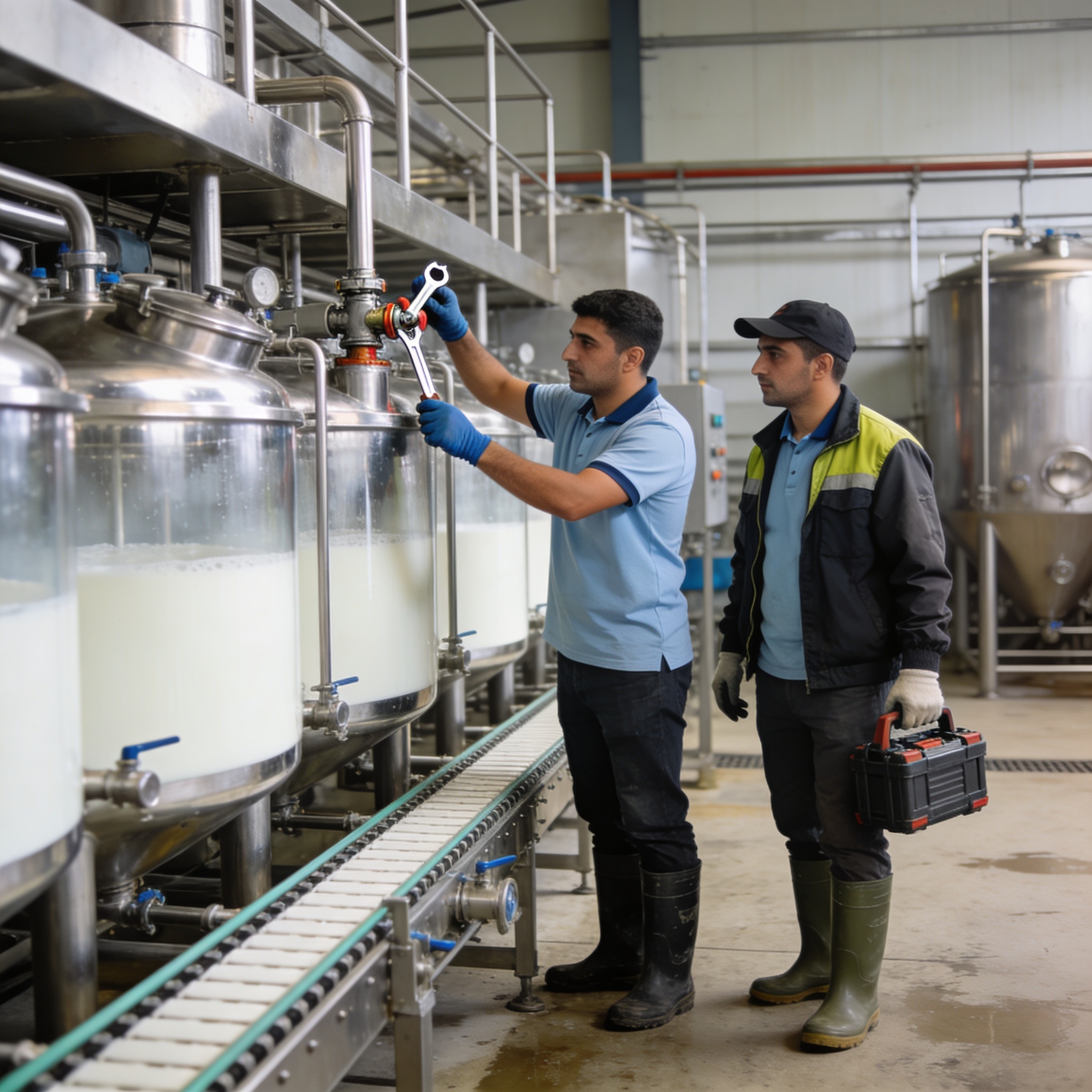
We sell scheduled maintenance and emergency repair contracts for the core equipment in dairy processing plants. Buyers pay because unexpected breakdowns stop production, spoil milk, and lose customers, creating urgent financial pressure.
Operator fit: The ideal operator has 5-10 years of hands-on experience as a mechanic or technician within a dairy plant, beverage factory, or industrial.
Decision snapshot
Investment
Setup budget still broad
Monthly profit
Broad owner-earnings estimate still needed
Payback
Payback range still broad
Customer type
B2B
Tech needed
Medium
Sector
—
Quick Decision
Small dairy plants cannot afford full-time in-house technicians, leaving them dependent on slow or unreliable outside help.
Original equipment manufacturers often provide poor after-sales service, with long delays for parts and visits, especially outside Baku.
If you cannot demonstrate deep technical knowledge of specific brands like Alfa Laval or GEA during the first visit, plant managers will not trust you with their critical lines.
What You Are Selling
Provide reliable preventive maintenance and fast-response repair for pasteurizers, separators, and fillers to small dairy processors who currently face costly downtime.
Who this is for: Small to mid-sized dairy processing plants, cheese producers, and yogurt makers who own pasteurizers, separators, and fillers but lack reliable technical support.
- Small dairy plants cannot afford full-time in-house technicians, leaving them dependent on slow or unreliable outside help.
- Original equipment manufacturers often provide poor after-sales service, with long delays for parts and visits, especially outside Baku.
How This Business Wins
Price by concrete delivery unit and cadence, with explicit starter scope and margin guardrails.
- Close the first client on the fixed-price Starter Assessment.
- Limit first contract to one bounded scope with written acceptance criteria.
- Convert to recurring terms only after proof on that first bounded scope.
- Use this unit anchor in quotes: price by delivered scope unit with recurring cadence where relevant.
- Set minimum commercial scope so early delivery cycles remain profitable.
- Align payment cadence to repeat usage and documented conversion checkpoints.
- Use this guardrail anchor: protect margin with explicit scope boundaries and staged commitments.
- Keep out-of-scope work and change requests on separate priced terms.
Customer and Buying Logic
Small to mid-sized dairy processing plants, cheese producers, and yogurt makers who own pasteurizers, separators, and fillers but lack reliable technical support. The buyer is the plant owner or operations manager facing urgent financial pressure from production stoppages and product spoilage during equipment failures.
- Plant Owner/Founder: Cares about protecting their capital investment in machinery and avoiding catastrophic downtime that loses key retail customers.
- Production Manager: Cares about hitting daily output targets and not being blamed for line stoppages; wants a reliable phone number to call for fast fixes.
- Quality Control Manager: Cares about consistent pasteurization temperatures and hygiene to pass audits and avoid product recalls; values preventive maintenance records.
- A critical pasteurizer failure results in an entire batch of milk being spoiled, creating an immediate need for expert help.
- The plant fails a hygiene audit due to poor equipment maintenance records, threatening contracts with supermarkets.
- The usual part-time mechanic retires or becomes unavailable, leaving the plant with no technical support at all.
Today, plant managers either try to perform basic maintenance with their own untrained staff or wait for a service technician from the original.
We win by guaranteeing a faster, more reliable local response than distant suppliers, and by providing the scheduled care that prevents emergencies,.
How You Get First Customers
- Identify regional dairy processors, cheese plants, and yogurt facilities through local food industry associations and trade publications focused on Azerbaijani agriculture.
- Visit regional milk collection and chilling centers to ask operators for referrals to nearby processing plants with aging equipment.
- Contact equipment suppliers for pasteurizers and fillers to request introductions to customers who have purchased machines but may need after-sales service.
Source accounts from local dairy industry contacts and supplier referrals.
- Direct, in-person visits to target plants, using the initial audit offer as a reason for the meeting.
- WhatsApp follow-up with production managers met at industry events, sharing short videos of similar repairs you've completed.
- Asking for referrals from your first two satisfied clients, offering them a credit against future work for any successful introduction.
- Open with a question about their biggest headache regarding equipment downtime in the last six months.
- Show a simple checklist of the 10 most common failure points in a dairy pasteurization line and ask how many they've experienced.
- Present the starter assessment as a low-risk way to get a full picture of their line's health, with no obligation for further work.
What You Need To Start
- Capex discipline: Standardize repair kits and high-failure parts inventory across all client contracts to minimize unique stock and enable bulk purchasing.
- Working capital discipline: Structure retainer contracts to require 50% upfront payment for scheduled quarterly maintenance, with the remainder due upon service completion.
- Utilization discipline: Route technicians using GPS scheduling to cluster preventive maintenance visits by geographic zone, maximizing billable hours per day and reducing travel costs.
- Business registration as a sole trader or limited liability company.
- General liability insurance to cover any potential damages while working on client property.
- A reliable vehicle suitable for carrying tools and parts.
- A comprehensive set of industrial mechanic's hand tools, metric and imperial.
- Specialized tools for dairy equipment: tube expanders for heat exchangers, laser thermometer, pressure gauges, and seal installation kits.
- The operator is the primary technician for the first year.
- A part-time administrator (can be a family member) to handle phone calls, scheduling, and basic invoicing after the first 3-4 clients are secured.
- Must have proven hands-on experience repairing pumps, valves, and heat exchangers, preferably in a food or dairy environment.
- Needs a valid driver's license and the willingness to travel extensively within a defined region to serve clients.
Risks
- If you cannot demonstrate deep technical knowledge of specific brands like Alfa Laval or GEA during the first visit, plant managers will not trust you with their critical lines.
- Parts sourcing from international suppliers can take weeks; you must identify reliable local machinists who can fabricate simple gaskets, seals, and impellers to avoid long downtimes.
- Collecting payment after emergency work can be difficult if you haven't established clear upfront terms; always get a signed work order with pricing before starting any repair.
First 6 Months
- 1Identify 20-30 target plants within a 2-hour drive radius, focusing on operations running at least two shifts daily.
- 2Visit 3-5 plants personally to inspect their equipment, understand their current maintenance struggles, and build initial trust.
- 3Offer a bounded first service: a full equipment assessment and one preventive maintenance session for a fixed fee, with a clear report.
- 4Use the assessment report to propose a tailored retainer contract, starting with quarterly preventive visits and a priority response rate for emergencies.
Final Verdict
This is an attractive opportunity because it addresses a clear, repeat commercial pain�costly downtime�for dairy processors with a service wedge independent of major equipment suppliers. The key risk is failing to establish technical credibility quickly, which would leave clients relying on ad hoc mechanics.
The ideal operator has 5-10 years of hands-on experience as a mechanic or technician within a dairy plant, beverage factory, or industrial equipment supplier. They know how to disassemble a centrifugal pump or troubleshoot a pasteurizer temperature loop. This person must be comfortable driving to remote plants, negotiating directly with the owner or production manager, and building trust through practical demonstrations of skill. A background in sales is less important than proven technical credibility.