Year-Round Mushroom Growing Rooms for Local Farms and Businesses
You will build and install insulated, climate-controlled rooms specifically for mushroom cultivation. Buyers pay because they need a dependable, local supply of fresh mushrooms that outdoor farming and imports cannot provide.
Operator fit: This is best run by someone with hands-on experience in construction, basic carpentry, or agricultural equipment.
Decision snapshot
Investment
AZN 62,250
Monthly profit
AZN 16,500
Payback
~15 months
Customer type
B2B and B2C
Tech needed
Light tech
Sector
Agriculture
Quick Decision
Supermarkets and restaurants pay a premium for fresh mushrooms but struggle with the quality and reliability of imports.
Azerbaijan's climate makes consistent, year-round mushroom farming outdoors impossible without controlled conditions.
Your first sales will depend on convincing farmers to make a significant upfront investment before they see their own harvest.
What You Are Selling
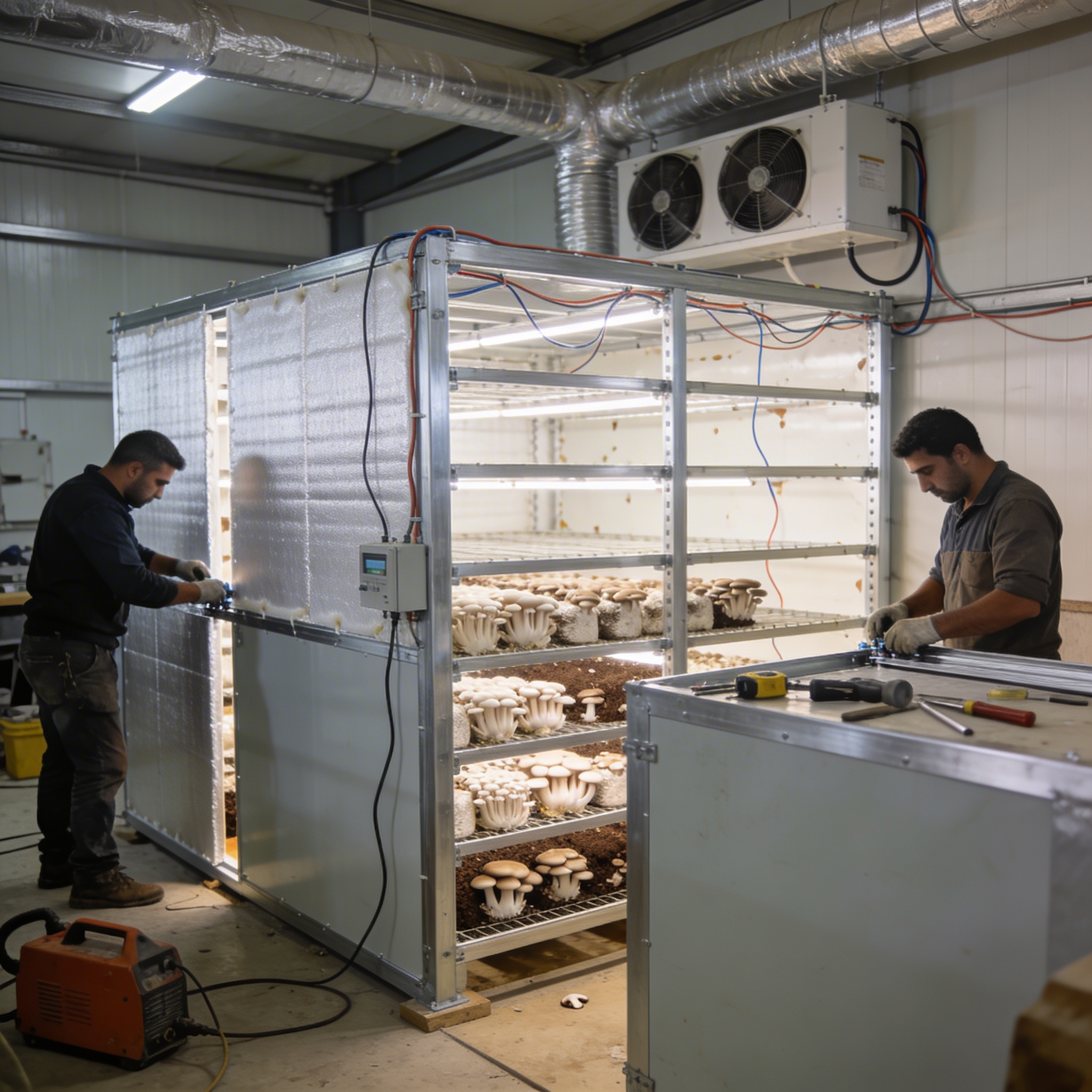
Sell and install compact, climate-controlled rooms that enable farmers and food businesses to grow fresh mushrooms reliably, replacing inconsistent imports.
Who this is for: Your ideal customer is a practical farm manager or small business owner who already manages daily operations, has some underutilized indoor space, and is frustrated by the cost or inconsistency of buying mushrooms.
- Supermarkets and restaurants pay a premium for fresh mushrooms but struggle with the quality and reliability of imports.
- Azerbaijan's climate makes consistent, year-round mushroom farming outdoors impossible without controlled conditions.
Financial Detail
| Item | Estimated cost |
|---|---|
| Climate control system & shelving | AZN 15,000 |
| Construction materials & insulation | AZN 11,500 |
| HVAC installation & electrical work | AZN 8,000 |
| Business registration & permits | AZN 2,250 |
| Initial mushroom spawn & substrate | AZN 3,000 |
| Working capital (3 months operating) | AZN 22,500 |
| Month 1 | Month 2 | Month 3 | Month 4 | Month 5 | Month 6 | Month 7 | Month 8 | Month 9 | Month 10 | Month 11 | Month 12 | |
|---|---|---|---|---|---|---|---|---|---|---|---|---|
| Revenue | AZN 0 | AZN 0 | AZN 0 | AZN 0 | AZN 0 | AZN 0 | AZN 12,000 | AZN 15,000 | AZN 18,000 | AZN 20,000 | AZN 22,000 | AZN 24,000 |
| Costs | AZN 7,500 | AZN 7,500 | AZN 7,500 | AZN 7,500 | AZN 7,500 | AZN 7,500 | AZN 7,500 | AZN 7,500 | AZN 7,500 | AZN 7,500 | AZN 7,500 | AZN 7,500 |
| Net profit | -AZN 7,500 | -AZN 7,500 | -AZN 7,500 | -AZN 7,500 | -AZN 7,500 | -AZN 7,500 | AZN 4,500 | AZN 7,500 | AZN 10,500 | AZN 12,500 | AZN 14,500 | AZN 16,500 |
| Investment recovery | AZN -69,750 | AZN -77,250 | AZN -84,750 | AZN -92,250 | AZN -99,750 | AZN -107,250 | AZN -102,750 | AZN -95,250 | AZN -84,750 | AZN -72,250 | AZN -57,750 | AZN -41,250 |
Net profit = monthly revenue minus operating costs. Investment recovery = estimated running cash position after deducting the full startup investment, calculated using monthly net profit midpoints. Turns positive when startup investment is fully recovered.
Figures are indicative midpoint estimates. Actual results depend on execution, location, and market conditions.
How This Business Wins
Price by the room, with a clear starter package for a single-room install, protecting margins with defined scope and deposits, then expand through additional rooms and service contracts.
- Your first sale should be to a farmer who is well-respected in their local community.
- Single-room starter package: includes one complete room, installation, and commissioning.
- Provides initial training and the first batch of spawn to begin cultivation.
- Base price per installed growing room, covering all climate-control and shelving systems.
- Adjust final price for room size (e.g., per square meter) and site-specific installation complexity.
- Include a fixed fee for initial commissioning, training, and the first batch of mushroom spawn.
- Require a 40% deposit upon contract signing to secure materials and schedule.
- Define a clear scope of work; any customer-requested changes are handled as paid change orders.
- Explicitly exclude ongoing maintenance and spawn supply from the initial installation price.
Customer and Buying Logic
Your ideal customer is a practical farm manager or small business owner who already manages daily operations, has some underutilized indoor space, and is frustrated by the cost or inconsistency of buying mushrooms from the market. They are financially stable enough to invest in equipment that will pay back in under two years.
- Farm Owner/Manager: Cares about adding a profitable new revenue stream without taking up valuable field space. Needs clear ROI calculation.
- Restaurant Chef/Owner: Cares about consistent quality, unique varieties, and a story of local sourcing for their menu. Needs reliable weekly delivery.
- Agricultural Dealer: Cares about having a unique, high-margin product to offer their existing farmer network. Needs training and support to sell it.
- A key supplier's import shipment is delayed or rejected at customs, leaving a restaurant without a critical ingredient.
- A farmer sees a neighbor successfully harvest their first batch of mushrooms and realizes the system actually works.
- A restaurant owner faces customer complaints about the quality or freshness of mushrooms in their dishes.
Buyers currently purchase mushrooms from wholesale markets, which are often supplied by imports from Iran or Russia.
You win by selling a complete, working system that a customer can walk into, not just a set of parts.
How You Get First Customers
- Identify smallholder farmers and agri-cooperatives through local agricultural extension offices and farming associations.
- Attend regional agricultural fairs and exhibitions where farmers gather to source new equipment and techniques.
- Directly contact restaurant groups and hotel procurement managers via professional networks, offering a site visit to demonstrate the prototype.
Target smallholder farmers and agri-cooperatives via direct outreach and agricultural supply store referrals.
- Direct farm visits in key agricultural regions, scheduled by phone call or WhatsApp message.
- Demonstrating the unit to groups of farmers at a local agricultural cooperative meeting.
- Word-of-mouth referrals from your first successful customers to other farmers in their network.
- Start with their current problem: 'Are you tired of paying high prices for mushrooms that are already old when you buy them?'
- Show a photo/video of your working room and a harvest: 'This is what a local farmer harvested last week, year-round.'
- Present a simple one-page calculation: cost of your system versus their current annual spend on imported mushrooms.
What You Need To Start
- Start by building only one demonstration unit; do not pre-build inventory.
- Require a 50% deposit from customers before ordering any materials for their specific room.
- Use a rented workshop month-to-month instead of leasing a long-term space initially.
- Standard business registration as a limited liability company or individual entrepreneur.
- A fire safety and electrical compliance certificate for your workshop, if required by local municipality.
- Basic woodworking and metalworking tools (saw, drill, screw guns, measuring tools).
- A vehicle suitable for transporting room panels and shelving to customer sites.
- A skilled carpenter or handyman for panel assembly and basic construction.
- A driver/installer who can help with delivery, basic installation, and customer site preparation.
- Practical experience in construction, assembly, or equipment repair.
- Comfort with visiting farms, building trust with local business owners, and discussing costs and returns plainly.
Risks
- Your first sales will depend on convincing farmers to make a significant upfront investment before they see their own harvest.
- If your spawn supplier has quality issues or delivery delays, your customers' harvests will fail, damaging your reputation.
- You must carefully manage the timing between paying for materials, workshop rent, and receiving customer payments to avoid cash shortages.
First 12 Months
- 1Rent a small workshop in an industrial area of Baku or Sumgayit to assemble room panels and shelving systems.
- 2Build one full-scale demonstration unit to prove yields, refine your build process, and use for customer visits.
- 3Visit 10-15 smallholder farmers in the Guba-Khachmaz or Lankaran regions, show them the working unit, and discuss the financials of adding mushrooms to their farm.
- 4Secure your first 2-3 orders with a 50% deposit to cover material costs, then deliver with installation and a starter supply of spawn.
Final Verdict
This is an attractive opportunity to establish a first-mover advantage in local controlled-environment agriculture. The key risk is customer cash flow, requiring careful deposit structures.
This is best run by someone with hands-on experience in construction, basic carpentry, or agricultural equipment. You need to be comfortable visiting farms, explaining practical benefits, and managing workshop assembly. A background in sales to local businesses or farmers is a strong advantage, as trust is built in person.